Why Choose Solar Panel Lights for Your Business?
Solar Panel Lights can make a business’s outdoor spaces useful after sunset without extending electrical wiring to every path, sign, or loading area. A row of lights along a walkway can guide visitors. A motion-activated fixture near a service entrance can add visibility when staff arrive early. The appeal is practical. So is the need to choose carefully.
Energy pioneer Thomas Edison is often credited with saying, “I’d put my money on the sun and solar energy. What a source of power!” His words capture solar energy’s promise, though they do not answer a buyer’s everyday questions about lighting. Those questions matter: How much sun reaches the panel? Will the battery support the required hours? Can the fixture handle shade, rain, and seasonal changes? A bright display in a showroom may not reflect performance on a building’s north-facing wall.
For businesses, the decision involves more than avoiding trenching or reducing grid use. It includes installation conditions, maintenance access, light placement, and the cost of replacing batteries over time. Solar Panel Lights can suit remote signs, parking edges, garden paths, and other locations where wiring is inconvenient. They may be a poor fit for deeply shaded areas or sites needing steady, high-output illumination all night. That deserves a second look. This guide explores the trade-offs, useful applications, and selection details that can help businesses decide where solar lighting makes sense—and where it may not.
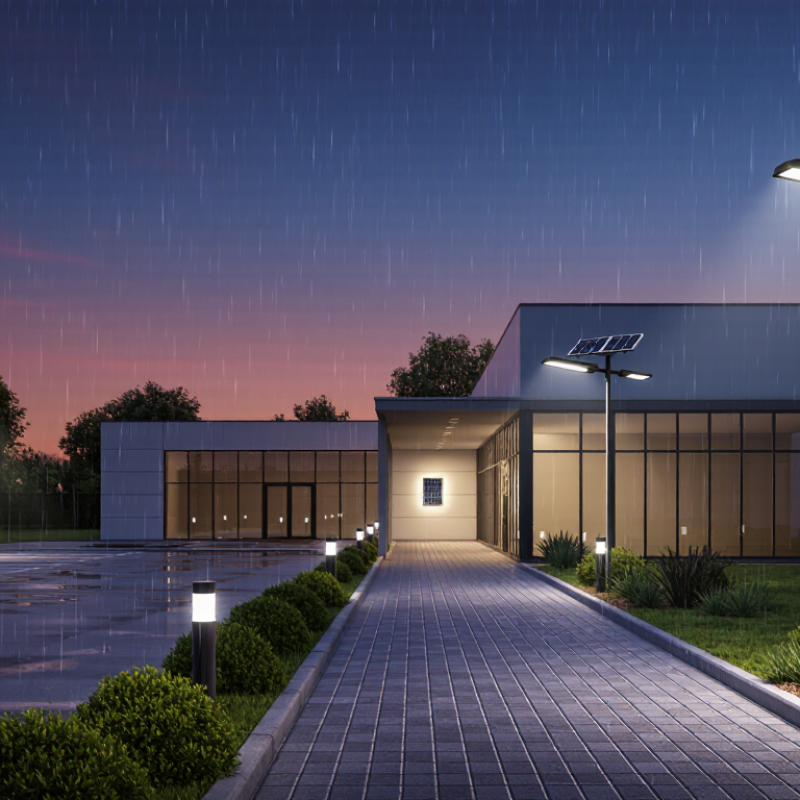
Table of Contents
[Hide]
What Solar Panel Lights Are and How They Work
Solar panel lights combine a photovoltaic panel, rechargeable battery, LED lamp, and control circuit. The panel converts sunlight into electricity during the day. That energy is stored in the battery for later use. At dusk, a light sensor can trigger the LEDs automatically, while the controller helps prevent overcharging and excessive discharge. The panel may sit on the fixture or connect by cable, which allows more flexible placement.
Brightness and operating time depend on panel size, battery capacity, weather, and daily sunlight. A shaded loading bay or several cloudy days can reduce performance. That matters. Solar lighting avoids the need for underground power cables, but it still needs thoughtful positioning and maintenance. Dust on a panel, an aging battery, or a poorly chosen fixture can lead to disappointing results. Check technical specifications for expected runtime and battery replacement guidance, rather than relying on brightness claims alone.
Tips: Place panels where they receive unobstructed daylight, and keep them clear of dust and leaves. Test the light after installation, including on darker evenings. One detail is easy to miss: a bright fixture may not stay bright all night. Choose output and runtime to suit the actual work area.
Why Choose Solar Panel Lights for Your Business? - What Solar Panel Lights Are and How They Work
| System element | What it is | How it works | Business relevance |
|---|---|---|---|
| Solar panel | A photovoltaic module made of solar cells. | During daylight, its cells convert sunlight into direct-current electricity. | Provides the light’s energy source. Output depends on sunlight, panel orientation, shading, and weather. |
| Charge controller | An electronic circuit that manages power between the panel and battery. | Regulates charging and helps protect the battery from unsuitable charging conditions. | Supports reliable operation and battery life; the controller type and features vary by product. |
| Rechargeable battery | An energy-storage unit, commonly lithium-based or nickel-metal hydride in standalone lights. | Stores electricity generated in daylight and supplies it to the light after dark. | Allows the light to operate without a continuous grid connection. Runtime depends on battery capacity, charge, and light settings. |
| LED light source | Light-emitting diodes that produce illumination using electrical energy. | The battery powers the LEDs when the lighting system switches on. | LEDs are widely used because they are energy-efficient and have a long operating life compared with many traditional lamp types. |
| Light sensor or control | A photocell, timer, motion sensor, or combination of controls, depending on the model. | A photocell can detect low ambient light; a timer or motion sensor can adjust when or how brightly the LEDs operate. | Automatic controls can reduce unnecessary lighting and help match operation to entrances, paths, signs, or parking areas. |
| Fixture and mounting | The housing, lens, and hardware that position and protect the light and, in some designs, the panel. | The fixture directs light toward the target area; its design determines how the panel and components are exposed to the environment. | Suitable placement and weather protection matter for outdoor use. Check the product’s stated environmental rating and installation requirements. |
| Daily operating cycle | The repeated charging and lighting process. | The panel generates electricity in daylight, the battery stores energy, and a control activates the LEDs when conditions or settings call for light. | Performance varies with season, shading, location, temperature, battery condition, and operating mode; check specifications against local conditions. |
Note: Components and features differ among solar lighting products. Actual output, runtime, charging time, and maintenance needs depend on the specific design and site conditions.
Related Posts
-
2026 Top Outdoor Solar Lamps Buying Guide
-

10 Surprising Facts and 7 Reasons Why Solar LED Lights Are Revolutionizing Outdoor Lighting
-
How to Choose the Best Solar Panel Lights for Your Outdoor Spaces
-
What is the Best Solar Driveway Lights for Your Home?
-
Top Solar Walkway Lights for Sustainable Outdoor Solutions?
-
How to Choose the Best Solar Lamp for Outdoor Lighting