2026 Top Outdoor Solar Lamps Buying Guide
Choosing the right outdoor lighting can feel simple until weather, battery life, and placement change the results. This 2026 Top Outdoor Solar Lamps Buying Guide examines what actually matters before you purchase. Solar Lamps Outdoor products now include pathway lights, motion-activated security lamps, wall fixtures, lanterns, and decorative garden models. Each type serves a different purpose.
A useful buying decision begins with the location. A lamp beneath dense branches may receive weak sunlight, even on bright days. Check the solar panel’s position, battery capacity, stated operating time, and lumen output. Also inspect the IP rating for rain and dust protection. Warm light can make a patio feel inviting, while brighter neutral light helps reveal steps and entrances. Motion sensors may save energy, but their range can be inconsistent near walls, shrubs, or busy streets.
Real-world performance is rarely identical to the product page. Seasonal daylight, freezing temperatures, dust, and shaded gardens all matter. No lamp is perfect. I have seen attractive models lose brightness after cloudy weeks, while modest lamps continued working because their panels were better placed. Manufacturer testing provides useful evidence, but independent reviews and warranty terms deserve equal attention. This guide compares practical features, installation effort, durability, appearance, and long-term value. It also highlights common buying mistakes, including confusing decorative brightness with useful illumination. A careful choice should fit your space, climate, maintenance habits, and safety needs. Sometimes, the cheapest option works well. Sometimes, it becomes an unwanted replacement project.
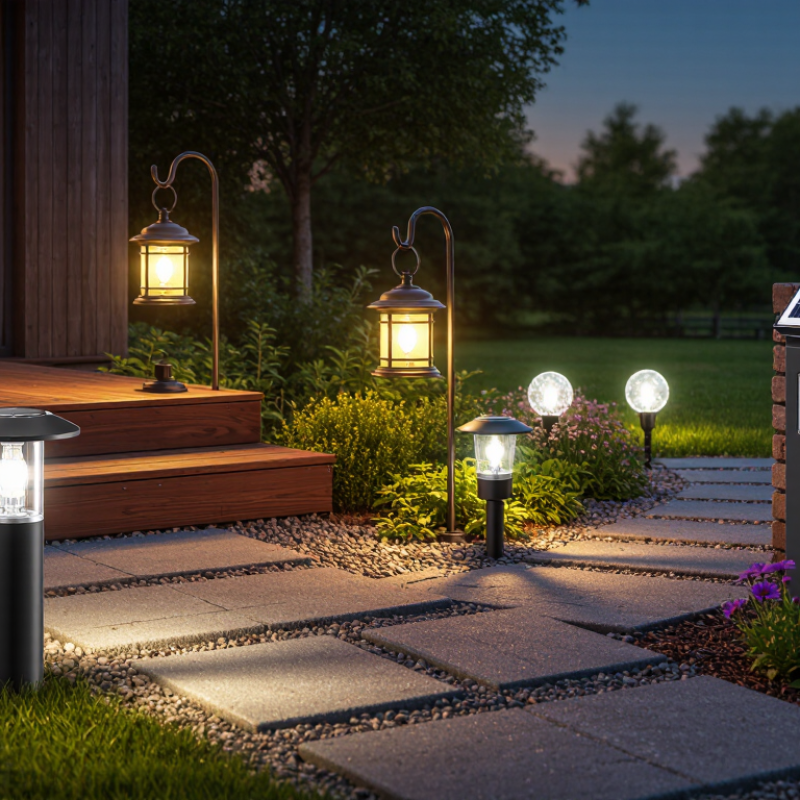
Table of Contents
[Hide]
Solar PV Basics: Compare 15–23% Module Efficiency Using NREL Data
Solar panel efficiency shows how much sunlight becomes electricity under standard test conditions. For outdoor solar lamps, a 15% module may need more surface area than a 23% module for similar output. NREL’s PVWatts documentation uses 19% as a representative crystalline-silicon module efficiency. This gives shoppers a practical midpoint. Small panels matter.
The 15–23% range is useful, but it is not a full performance promise. Fraunhofer ISE’s Photovoltaics Report 2024 places modern commercial modules broadly within the low-to-mid 20% range, while field output falls with heat, dust, shade, and poor orientation. A lamp facing a wall may collect far less energy than its label suggests. That gap matters. Check the panel’s rated wattage, not efficiency alone. A larger 15% panel can outperform a tiny 23% panel because it captures more total sunlight.
NREL’s solar-resource and PV performance research also supports checking local irradiance before comparing lamp designs. In northern winter conditions, shorter days reduce charging time sharply. I have found that efficiency claims often look precise, yet real gardens are uneven, cloudy, and obstructed. The test setup is cleaner than the installation. Use efficiency as a screening measure, then inspect panel area, battery capacity, charge time, and seasonal runtime. Ask for a test report when specifications seem unusually optimistic.
2026 Top Outdoor Solar Lamps Buying Guide - Solar PV Basics: Compare 15–23% Module Efficiency Using NREL Data
| PV efficiency / specification | Approx. rated output from 1 m² at 1,000 W/m² | What it means for a solar lamp | Best use case | Buying guidance |
|---|---|---|---|---|
| 15% Lower-efficiency crystalline-silicon planning band |
150 W | Requires more panel area to collect the same energy. Useful where the lamp has a larger exposed panel. | Large garden lights, wall lights, and locations with adequate daytime exposure | Check panel dimensions and avoid shaded mounting positions. |
| 17% Mid-range crystalline-silicon planning band |
170 W | Provides approximately 13% more rated power per square metre than a 15% panel. | General pathway, porch, and decorative outdoor lighting | A useful balance between panel size, energy collection, and cost. |
| 20% Higher-efficiency crystalline-silicon planning band |
200 W | Produces approximately 33% more rated power per square metre than a 15% panel. | Compact lamps, narrow wall areas, balconies, and partly space-limited installations | Prioritize verified panel dimensions and rated battery capacity, not efficiency alone. |
| 23% Upper-end crystalline-silicon planning band |
230 W | Produces approximately 53% more rated power per square metre than a 15% panel, but actual daily energy still depends on sunlight and temperature. | Small premium-format panels and installations with limited panel area | Confirm that the advertised percentage refers to module efficiency rather than laboratory cell efficiency. |
| Buying dimension | Useful specification or range | Why it matters | Selection recommendation |
|---|---|---|---|
| Solar-panel area | Compare the actual length × width, not only the efficiency percentage. | A larger lower-efficiency panel can collect more total energy than a very small high-efficiency panel. | Use panel area, efficiency, and expected sunlight together. |
| Battery capacity | Reported in watt-hours (Wh) or milliamp-hours (mAh). Wh is easier to compare when voltage differs. | The battery stores energy for operation after sunset and during cloudy periods. | Compare capacity with lamp power and claimed runtime; do not compare mAh without voltage. |
| Light output | Lumens (lm) measure total visible light output. | Higher lumens generally provide brighter illumination, but beam angle and mounting height also affect useful light. | Choose wider beams for paths and focused beams for entrances or security areas. |
| Runtime | Look for a stated runtime at a defined brightness setting. | Maximum runtime is often measured in a low-light mode and may not represent full brightness. | Prefer models with adjustable brightness or motion-activated modes for energy savings. |
| Weather resistance | IP65 protects against dust and water jets; IP66 provides stronger water-jet protection; IP67 allows temporary immersion under specified test conditions. | The rating describes protection against solids and water, not guaranteed resistance to every climate or installation error. | Use at least IP65 for exposed outdoor locations and inspect seals periodically. |
| Operating temperature | Check the manufacturer’s stated temperature range for the battery and electronics. | Cold temperatures can reduce battery performance, while heat can accelerate battery aging. | Install the battery where it is ventilated and protected from unnecessary heat. |
| Light sensor and controls | Dusk-to-dawn sensors, timers, motion sensors, and brightness controls | Controls determine when stored energy is used and can substantially affect overnight runtime. | Select motion activation for security lighting and steady low brightness for pathways. |
| Installation orientation | Unshaded exposure with the panel facing the strongest available daylight | Shade from walls, trees, railings, or dirt can reduce charging energy even when the panel has a high laboratory efficiency. | Keep the panel clean and avoid locations that receive regular midday shade. |
Technical note: The output figures use the standard photovoltaic test irradiance of 1,000 W/m² and the calculation
power = area × irradiance × efficiency. They are theoretical nameplate comparisons, not guaranteed daily energy production.
NREL efficiency charts primarily report best research-cell results; commercial module efficiency can be lower because of module-level interconnections,
glass, framing, temperature, angle, shading, and other system losses. Always verify the product’s published module efficiency, panel area, battery energy,
and test conditions before purchasing.
Reference: National Renewable Energy Laboratory (NREL), “Best Research-Cell Efficiencies” chart and photovoltaic performance resources.
Related Posts
-
Discover the Best Street Light Solutions Directly from Top Chinese Manufacturers
-

What are the Benefits of Using Solar Powered Lights for Your Home
-
How to Enhance Urban Safety with Smart Street Light Solutions
-
Essential Tips for Sourcing Top Manufacturers of Best Solar Walkway Lights
-
Elevating Global Standards with Best Solar Walkway Lights Made in China
-
How to Choose the Best Solar Panel Lights for Your Outdoor Spaces