2026 Top Street Light Types for Global Buyers
In 2026, global buyers will compare more than brightness when choosing a Street Light. They will weigh energy use, installation needs, maintenance access, and performance in local weather. The “top” option depends on the road, site, and available infrastructure. There is no single best fit.
Common choices include LED roadway lights, solar street lights, smart connected systems, area lights, decorative fixtures, and high-mast designs. Each serves a different setting. A roadway fixture needs suitable optics to direct light along lanes, while a solar unit depends on panel exposure, battery capacity, and seasonal sunlight. Smart controls can support dimming and monitoring, but only when communication coverage and operating plans are reliable. Details matter. Check photometric data, color temperature, ingress protection, warranty terms, and replacement-part availability—not just the advertised wattage.
This guide introduces key Street Light types and the factors buyers can use to compare them. It considers roadway layouts, parks, industrial sites, and off-grid locations, alongside practical questions about installation and long-term upkeep. Requirements and infrastructure differ between markets, so product documents should be checked against the project’s local specifications. A low purchase price may not mean a lower lifetime cost. Nor does a feature-rich fixture automatically suit every site. Some comparisons remain imperfect without a lighting plan or on-site assessment. Use the categories here as a starting point, then confirm performance with qualified project professionals before selecting a system.
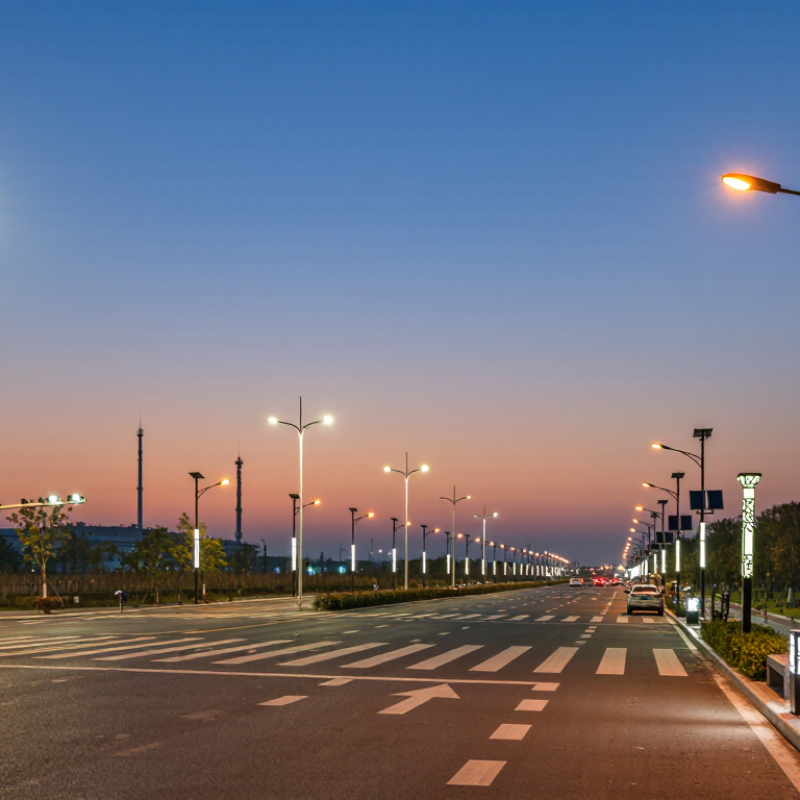
Street-Light Categories: EN 13201 Defines M, C, and P Road Classes
For global buyers, EN 13201 offers a practical way to describe road-lighting needs. It does not prescribe one lamp shape or wattage. Instead, it groups lighting situations into classes, including M, C, and P. M classes generally apply to motorized traffic, such as vehicles moving along main roads. Their assessment focuses on road-surface luminance, including uniformity and glare. C classes suit conflict areas, such as junctions and roundabouts, where vehicle paths cross or change. They are assessed mainly through illuminance. P classes serve pedestrians and cyclists on paths, residential streets, and similar spaces. That distinction matters.
A buyer should match the class to the actual site, not just the road name. For an M-class road, check traffic speed, surface luminance, and spacing between poles. For a C-class junction, look closely at visibility across crossings and turning areas. P-class designs need comfortable light on walking surfaces, with attention to uniformity and glare. Small details count. Mounting height, optical distribution, nearby trees, and reflective surfaces can change the result. A tidy class label can still miss local conditions. Review the project’s EN 13201 requirements and the applicable national guidance, then confirm the design with measured or calculated performance.
LED Street Lights: U.S. DOE Reports 50%+ Energy-Saving Potential
2026 Top Street Light Types for Global Buyers
LED Street Lights: U.S. DOE Reports 50%+ Energy-Saving Potential
LED street lights can use substantially less energy than older lighting systems. The U.S. Department of Energy reports potential energy savings of more than 50%. Actual results depend on the existing fixtures, operating hours, and control settings. A road with lights running all night may benefit from dimming during quiet hours. But savings are not automatic. Poorly selected optics can leave sidewalks or crossings too dim, even when the power bill falls.
Tips: Compare light distribution, color temperature, and rated performance before choosing fixtures. Check the road layout at night, not only on a product sheet. Keep a simple record of energy use before and after installation.
For global buyers, LED street lights suit many roads, parking areas, and public spaces, but one design rarely fits every site. Match the fixture to pole height, spacing, weather exposure, and maintenance access. Ask for test data and clear warranty terms. A frequent planning mistake is focusing only on purchase price; installation and replacement access matter too. There is a trade-off. Dimming controls may improve savings, yet they need careful setup and monitoring. Review the results after installation, since real streets can reveal gaps that drawings miss.
2026 Top Street Light Types for Global Buyers - LED Street Lights: U.S. DOE Reports 50%+ Energy-Saving Potential
| Street Light Type | Typical Applications | Light Distribution | Common Mounting | Buyer Considerations |
|---|---|---|---|---|
| Roadway LED (cobrahead style) | Urban and suburban streets, arterial roads, and highways | Road-focused optics direct light along the carriageway; distribution should be selected to suit road width and pole spacing. | Side-mounted arm on a street-light pole | Check roadway lighting requirements, pole spacing, mounting height, glare control, and photometric calculations for the site. |
| Full-cutoff LED roadway light | Roads and areas where limiting uplight and light trespass is a priority | Designed to minimize light emitted above the horizontal when installed in the specified orientation. | Arm-mounted or tenon-mounted | Confirm the fixture classification and installation angle. Optics and aiming affect both useful illumination and spill light. |
| Area and shoebox LED light | Parking lots, campuses, commercial sites, and large paved areas | Broad area distributions are available, with asymmetric options for directing light across a site. | Usually mounted on a pole or area-lighting bracket | Review site layout, property boundaries, glare, uniformity, and whether the selected distribution suits the mounting position. |
| Post-top LED light | Pedestrian streets, parks, plazas, and residential paths | Often provides a more symmetrical distribution for walkways and open pedestrian spaces. | Mounted on top of a post or pole | Consider pedestrian comfort, optical shielding, pole height, and the visual character of the public space. |
| Solar LED street light | Remote roads, paths, and locations where grid connection is difficult or costly | Distribution depends on the LED optical system; solar power availability depends on the panel, battery, and local conditions. | Integrated or separately mounted solar panel on a pole | Size the system for local solar resource, required operating hours, autonomy during cloudy periods, battery temperature, and maintenance access. |
| Dimmable or adaptive LED street light | Roads and public areas where lighting levels can be adjusted by schedule, occupancy, or a control system | Uses roadway or area-light optics; dimming changes output rather than the basic optical distribution. | Commonly arm-mounted, with compatible control gear and a control interface | Verify dimming compatibility, control protocol, operating schedule, minimum output, and the applicable local lighting requirements. |
| Pedestrian-scale LED light | Sidewalks, cycle paths, residential streets, and public-realm areas | Optics are selected for pedestrian routes and nearby surroundings rather than vehicle lanes alone. | Lower poles, columns, or pedestrian-scale brackets | Assess visibility, uniformity, glare, surrounding windows, and the required lighting level for the route. |
Energy-saving note: The U.S. Department of Energy has reported that LED street-lighting upgrades can offer energy savings of 50% or more compared with conventional lighting in suitable applications. Actual savings vary with the existing system, LED design, operating hours, controls, and project requirements; verify performance with a site-specific assessment.
Solar Street Lights: Size PV Panels and Batteries for Site Autonomy
Start with the light’s actual nightly energy use, not its advertised wattage. A 40-watt LED running for 12 hours uses about 480 watt-hours each night. Dimming schedules can reduce this load, but measure the real operating profile where possible. Small errors add up.
For battery sizing, multiply daily energy use by the number of autonomy days, then allow for usable battery capacity and conversion losses. For example, three nights at 480 watt-hours require 1,440 usable watt-hours. If only 80 percent of nominal battery capacity is planned for use, the battery needs at least 1,800 watt-hours before additional design margins. Cold weather, aging, and long cloudy periods can change the result. Real sites are messier.
Size the PV array using the site’s weakest-season sun hours, not its annual average. Divide daily energy demand by peak sun hours and expected system efficiency. At four peak sun hours and 70 percent efficiency, a 480-watt-hour load suggests roughly 172 watts of panels, before adding capacity to recover after cloudy days. Check nearby trees, pole orientation, dust, and seasonal shade. A neat spreadsheet can still miss a tree that shades the panel at 4 p.m. Recheck assumptions against local weather and operating records.
HPS and Metal-Halide Street Lights: Compare Options Using IES RP-8
HPS and metal-halide street lights remain relevant where existing infrastructure, maintenance plans, or project budgets favor discharge lamps. HPS lamps typically provide higher efficacy and long service life, but their amber-toned light makes some colors harder to distinguish. Metal-halide lamps produce whiter light and generally better color rendering. Their output and color can shift as lamps age, and replacement timing matters. Both types need compatible control gear and time to warm up; neither behaves like instant-on LED lighting.
Use IES RP-8 as a planning reference, not a shortcut to choosing a lamp. Define the roadway lighting class and evaluate maintained illuminance or luminance, uniformity, and glare. Then compare verified photometric files for the complete luminaire, using the actual pole height, spacing, road width, and surface assumptions. A lamp’s rated output alone cannot predict what reaches the pavement. Check maintenance factors too, since dirt and lumen depreciation can change results over time. A spreadsheet can make this look tidier than field conditions really are.
Tips: Request a project-specific photometric layout and confirm lamp, ballast, and fixture compatibility. If color recognition matters, compare metal-halide samples in place; if operating cost dominates, check HPS energy and maintenance estimates against local conditions.
Global Buyer Checks: Verify IEC 60598-2-3 and EN 13201 Compliance
2026 Top Street Light Types for Global Buyers
Global Buyer Checks: Verify IEC 60598-2-3 and EN 13201 Compliance
Street-light choices include roadway LED luminaires, post-top lights, and high-mast systems. Match the type to road width, mounting height, and required light distribution. IEC 60598-2-3 addresses particular safety requirements for road and street lighting luminaires. Ask for test documentation tied to the exact model, including its housing, driver, and optics. Check the report’s edition and testing laboratory. A certificate alone is not enough.
EN 13201 helps buyers assess road-lighting performance, including lighting classes and calculation or measurement methods. It does not make every luminaire suitable for every road. Request photometric files and a project calculation showing the chosen class, spacing, pole height, and uniformity. Compare the calculation with the installed design. Small changes matter. Local requirements and adopted editions can differ, so confirm them with the project authority before purchase.
Tips: Match every report to the quoted model and configuration. Check glare, ingress protection, operating temperature, and dimming details. I have seen paperwork look complete while covering a different optic. Recheck the details.
2026 Top Street Light Types for Global Buyers
Global buyer check: verify IEC 60598-2-3 safety compliance and select lighting levels appropriate to the EN 13201 road class.
How to read this chart: EN 13201 P classes specify maintained average illuminance targets for relevant pedestrian and low-speed traffic areas. The values are class requirements, not the light output of a particular street-light type; final selection depends on site conditions and photometric design.
Reference: EN 13201-2:2015, P-class maintained average illuminance requirements. IEC 60598-2-3 covers safety requirements for road and street lighting luminaires.
Related Posts
-
Top Street Light Buying Tips for Global Procurement Needs?
-
How to Choose the Best Solar Pathway Lights?
-
Top Solar Walkway Lights for Sustainable Outdoor Solutions?
-
China Top Solar Lights Outdoor Suppliers?
-

How to Choose Commercial Solar Lights for Your Business?
-
Explore the Rising Demand for Parking Lot Lights at the Record Breaking 2025 Canton Fair