What Is Translucent Glass and What Is It Used For?
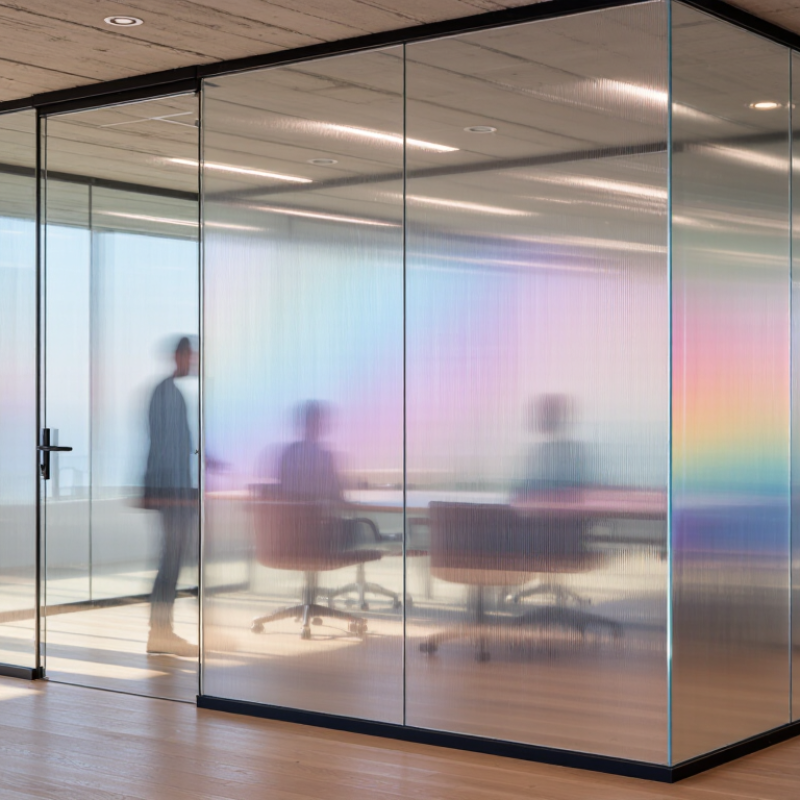
Light passes through Translucent Glass, but clear images usually do not. Instead, the material scatters light, softening outlines and limiting direct views. The result can feel bright without feeling exposed. Think of daylight filtering through a bathroom window or a meeting-room partition that blurs movement on the other side.
“Translucent” describes an optical effect, not one specific glass product. It can come from a frosted or etched surface, a textured pattern, or a specially formulated glass. Each option diffuses light differently. Some provide a gentle haze; others obscure details more strongly. That difference matters. A sample that looks private in a showroom may appear less so when sunlight or indoor lighting changes.
Designers and property owners use translucent glass in doors, office dividers, shower enclosures, sidelights, and decorative features. It can help daylight travel through a space while reducing direct visibility. It is not automatically a substitute for blinds, and it does not necessarily provide sound insulation. The exact performance depends on the glass, its finish, its installation, and the lighting around it.
There are trade-offs. Fingerprints may show on some finishes, while textured surfaces can take more effort to clean. Safety also depends on the product and where it is installed; translucency alone does not mean glass is tempered or laminated. Ask a qualified glazier for product specifications and check applicable building requirements. A small sample is useful, but it cannot reproduce every lighting condition. That is worth remembering.
What Translucent Glass Is and How It Differs from Clear Glass
Clear glass transmits light while preserving a sharp view through it. Translucent glass also admits light, but scatters it, softening shapes behind the pane. Think of sunlight crossing a frosted bathroom door: the room brightens, while a person’s outline becomes indistinct. Not fully private. The degree of blur depends on the surface texture, glass thickness, and light direction, so “translucent” does not guarantee complete privacy.
Visible-light transmittance helps compare products. Industry glazing data commonly place 3-millimeter clear float glass near 90 percent transmission; thicker or coated glass can differ. Lawrence Berkeley National Laboratory’s International Glazing Database records measured spectral properties for thousands of glazing products, illustrating why one figure cannot describe every glass type. Transmittance measures how much light passes through; it does not, by itself, show how clearly objects remain visible. That distinction matters in offices, partitions, and shower enclosures. A bright panel may still reveal movement or shadows, especially when the space behind it is strongly lit. I’d check a sample at the actual installation angle before specifying it; lighting can change the impression more than expected.

How Translucent Glass Filters Light and Limits Visibility
Translucent glass passes daylight while scattering it, softening sharp beams into a more even glow. Frosted, patterned, and acid-etched surfaces each scatter light differently. Shapes may become blurred silhouettes, not disappear entirely. Visibility also changes with lighting: a bright room viewed from a dark corridor can reveal more than expected. At night, interior lights may make figures easier to see from outside. This detail is easy to overlook.
The U.S. Energy Information Administration’s 2018 Commercial Buildings Energy Consumption Survey reported that lighting used about 17% of commercial-building electricity. Translucent glazing can help bring daylight into offices, bathrooms, and interior partitions, potentially reducing the need for electric lights. But glass alone does not guarantee energy savings; window direction, shading, and lighting controls matter. It can also make a small room feel brighter while leaving fine visual tasks harder.
Tips: Test a sample in the actual opening, both day and night. Check silhouettes from the viewing distance, and pair the glass with a curtain or blind where privacy matters. Even a well-chosen texture can disappoint under strong backlighting.
Common Types and Ways Translucent Glass Is Made
Translucent glass softens direct views while allowing daylight to pass through. Its appearance depends on both the glass surface and the way it is made. Frosted glass has a fine, cloudy texture. It is often produced by acid etching or abrasive blasting, which scatters light across the surface. The result can feel private without making a room gloomy. Not always, though: strong light behind it may still reveal vague shapes.
Patterned glass is formed by pressing a textured roller against hot glass. Ribs, waves, and small geometric marks distort images while creating noticeable surface detail. It suits doors, shower screens, and partitions where privacy and decoration matter. Textured patterns can also collect dust more visibly. That detail is easy to overlook.
Another option is laminated translucent glass, made by bonding glass sheets around a light-diffusing interlayer. The interlayer can create an even, softly glowing panel, useful for interior screens and backlit features. Ceramic frit coatings offer a different route: tiny ceramic particles are applied and fired onto the glass, producing durable bands, dots, or broader translucent areas. Each method changes light differently, so a sample viewed in the intended room is more useful than a catalogue image. The right choice depends on privacy, cleaning, light levels, and how much texture feels comfortable.
Where Translucent Glass Is Used in Buildings and Products
Translucent glass is useful where a room needs daylight without a clear view through it. In offices, it appears in partition walls and meeting-room doors, softening sightlines while keeping spaces bright. In homes, it suits bathroom windows, shower screens, stairwell panels, and front-door sidelights. Textured or acid-etched surfaces scatter light; laminated versions can add privacy without relying on curtains. Soft light, fewer harsh shadows. Yet privacy varies with lighting, so a panel that looks opaque by day may reveal shapes at night.
On building façades, translucent panels can bring diffuse daylight into corridors, atriums, and north-facing rooms. Skylights and canopies use similar glass to limit direct glare, though orientation and shading still matter. The U.S. Department of Energy’s 2021 Buildings Energy Data Book reports that lighting accounted for roughly one-tenth of commercial-building site energy use in 2018. That figure is not a promise of savings: daylight controls, room depth, and maintenance affect actual results. In products, translucent glass appears in cabinet doors, lamps, appliance panels, and display cases. Designers should check visible-light transmission and specify impact-rated glazing where people may strike the panel. The balance can be tricky. More diffusion may mean less view, and the best choice depends on the room.
Factors to Consider When Choosing Translucent Glass
Choosing translucent glass starts with the room’s purpose. A bathroom needs dependable privacy, while a kitchen may benefit from soft daylight and clear silhouettes. Frosted, etched, and patterned surfaces scatter light differently; ask for a sample and view it from both sides. Lighting matters. A pane that looks private in a showroom can reveal more when a bright room sits behind it at night. Check the manufacturer’s stated visible-light transmittance and privacy performance, rather than judging by appearance alone.
Thermal performance deserves equal attention, especially on large exterior windows. The U.S. Department of Energy’s Energy Saver guidance estimates that windows account for 25–30% of residential heating and cooling energy use. That figure covers windows broadly, not translucent glass alone. The International Energy Agency’s 2023 Global Status Report for Buildings and Construction also reports that buildings consume about 30% of global final energy. These figures make glazing worth evaluating, but they do not predict one room’s bills. Compare the complete window assembly’s U-factor and solar heat gain coefficient, using ratings from the National Fenestration Rating Council where available. Also consider safety glazing, edge exposure, cleaning access, and local climate. A textured surface can collect grime. That detail is easy to miss.