What Are the Top Electric Tricycle Manufacturers in China?
China’s Electric Tricycle industry combines mature manufacturing with rapid product experimentation. Hundreds of suppliers compete across cargo, passenger, delivery, and rural mobility applications. However, factory size alone does not prove manufacturing strength.
Micromobility analyst Horace Dediu once said, “Micromobility is the biggest thing to happen to transportation in a long time.” His observation helps explain why electric tricycles deserve closer attention. These vehicles now serve warehouses, farms, markets, campuses, and last-mile delivery routes.
This guide examines the top Electric Tricycle manufacturers in China through practical criteria. It considers production experience, motor integration, battery options, frame quality, testing systems, and after-sales support. Export readiness also matters. Reliable manufacturers should provide clear specifications, traceable components, and consistent documentation.
Small details reveal important differences. A reinforced rear axle can affect cargo stability. Battery placement can change handling and service time. Brake performance matters on sloped roads. Welding quality matters under repeated loads.
No ranking is perfect. Product quality may vary between factory batches, and online catalogs can hide meaningful limitations. Some manufacturers excel at customization but lack strong international support. Others offer polished exports but fewer low-cost options.
The companies discussed here are not judged by marketing claims alone. Their capabilities should be checked through factory audits, sample testing, certification reviews, and customer references. Buyers should also clarify warranty coverage and spare-parts availability before placing an order.
The strongest supplier is rarely the cheapest one. It is the manufacturer that matches vehicle design, operating conditions, and long-term service expectations.
Electric Tricycle Manufacturing in China: Market Scope and Product Types
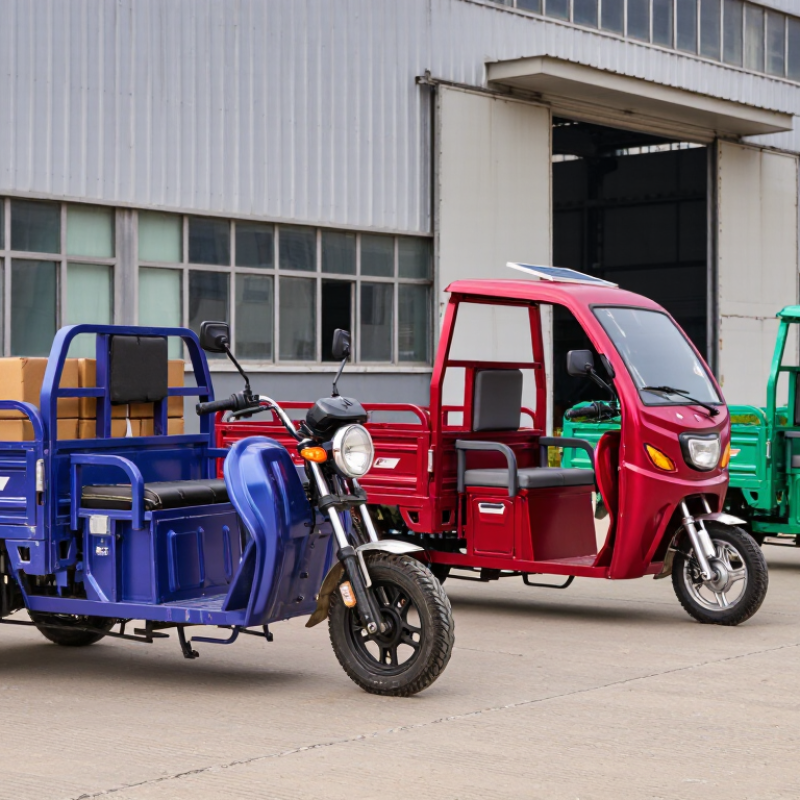
China’s electric tricycle manufacturing market covers passenger, cargo, logistics, and utility models. Demand is strongest where narrow streets, short delivery routes, and low operating costs matter. The China Bicycle Association reported about 42.28 million electric bicycle units produced in 2023. That figure does not isolate tricycles, but it shows the scale of China’s light electric mobility supply chain.
The International Energy Agency reported that electric two- and three-wheelers represented more than half of global electric vehicle sales in 2023. China remains a major production and consumption center. Manufacturers commonly offer rear cargo platforms, enclosed passenger cabins, flatbed utility bodies, and refrigerated delivery layouts. Battery choices usually include lead-acid and lithium-ion systems. Payload, hill performance, braking distance, and charging time deserve closer attention than headline motor power.
Some factories focus on large-volume OEM orders, while others build customized vehicles for municipal services, farms, and last-mile distribution. Reliable suppliers should provide battery test records, frame fatigue data, controller specifications, and clear after-sales procedures. Product classifications and road-use requirements can vary by destination market. That part is often underestimated. Market reports also group electric tricycles with broader three-wheeler categories, so published forecasts may look more precise than they really are. Buyers should verify production capacity through sample inspections, factory audits, and recent shipment records.

Key Criteria for Evaluating Chinese Electric Tricycle Manufacturers
Choosing among China’s top electric tricycle manufacturers requires more than comparing online prices. A reliable evaluation begins with production experience, engineering depth, and transparent documentation. Ask how long the factory has built electric utility vehicles. Review battery integration, motor matching, frame welding, and brake design. Factory photos are not enough. Request recent inspection records and production samples.
A serious supplier should explain its quality-control process clearly. Check incoming battery tests, welding inspections, waterproofing checks, and final road testing. Ask for load-capacity data under realistic conditions, such as uneven roads and repeated starts. Examine the wiring closely. Loose connectors and poorly protected cables often reveal rushed assembly. Certification documents should match the exact model, battery system, and intended market. Generic certificates deserve careful questioning.
After-sales support also separates capable manufacturers from trading intermediaries. Confirm spare-parts availability, warranty procedures, software support, and technician response times. A written service agreement is more useful than friendly promises. Communication matters too. Can the engineering team answer technical questions without avoiding details? Can it modify a cargo box, seat, or controller safely? Price still matters, but the cheapest quotation may hide weaker cells or thinner steel. No checklist is perfect. Sample testing can miss problems that appear after months of vibration. Independent inspection adds cost, yet it may prevent expensive failures later.
What Are the Top Electric Tricycle Manufacturers in China?
Key Criteria for Evaluating Chinese Electric Tricycle Manufacturers
This neutral 100-point procurement framework prioritizes product reliability, battery safety, after-sales support, customization capability, production capacity, regulatory compliance, and total cost. It is designed for comparing manufacturers without publishing individual company or brand data.
Leading Chinese Electric Tricycle Manufacturers and Their Strengths
China’s leading electric tricycle manufacturers compete through practical engineering, not only production volume. Industry coverage from Research and Markets identifies cargo capacity, battery range, and fleet durability as major purchasing factors in China’s electric three-wheeler sector. The strongest factories usually operate integrated welding, painting, assembly, and battery-testing lines. Buyers should inspect frame thickness, brake response, and load stability in person. Numbers can look impressive.
Cargo-focused manufacturers often build reinforced rear platforms, lower loading heights, and modular boxes for urban deliveries. Passenger-oriented producers emphasize wider benches, stronger suspension, weather covers, and easier entry steps. According to the China Bicycle Association’s industry reports, China remains a major manufacturing and export base for electric two- and three-wheeled vehicles, supported by dense component networks. This shortens sourcing time and enables small design changes. However, supplier quality can vary between batches.
Battery integration is another clear strength. Better manufacturers test cells, controllers, chargers, and wiring as one system instead of treating them as separate parts. Market research from IMARC Group also links electric three-wheeler growth with last-mile logistics and lower operating costs. Yet range claims deserve caution. Payload, hills, temperature, and tire pressure change results quickly. A factory may offer attractive customization, but excessive options can weaken quality control. Export buyers should request test records, warranty terms, spare-part plans, and independent compliance documents before placing large orders.
Product Comparison: Design, Performance, Safety, and Customization
When comparing electric tricycle manufacturers in China, I examine the frame before admiring the paint. A stable design uses reinforced joints, balanced weight distribution, and practical access for battery maintenance. Low step-through frames help older riders, while wider seats improve daily comfort. Looks are not enough. Some polished samples feel poorly balanced after loading cargo.
Performance depends on more than motor wattage. I test acceleration, hill climbing, braking response, and battery range with realistic loads. A useful model should move steadily on uneven roads without excessive vibration. Controllers should deliver smooth power, not sudden surges. Range claims require caution because temperature, rider weight, tire pressure, and hills change results. A short route test can mislead buyers.
Safety requires hydraulic or mechanical brakes, bright lighting, reflectors, mirrors, and reliable parking support. I also check wiring protection and battery enclosure quality. Small details matter near rain, dust, and repeated charging. Customization may include cargo boxes, seating layouts, wheel sizes, suspension, colors, and control settings. However, excessive customization can delay production or complicate replacement parts. I prefer suppliers that provide drawings, sample approval, inspection records, and clear warranty terms. My own comparisons are not perfect; factory samples may perform better than later batches. Independent testing remains valuable before placing a large order.
How to Select a Reliable Electric Tricycle Manufacturer in China
Selecting a reliable electric tricycle manufacturer in China requires more than comparing prices. A polished website proves little. Start with evidence. Request the factory address, production photos, and a live video inspection. Check whether the facility controls welding, painting, assembly, and final testing. Ask for documented quality procedures, not general promises. An experienced supplier should explain motor power, battery chemistry, payload limits, braking performance, and expected range under real loads. Short answers deserve caution.
Request a sample unit before placing a larger order. Test it on slopes, uneven pavement, tight turns, and repeated starts. Test it yourself. Record noise, frame flex, charging time, and braking distance. Ask how battery cells are matched and protected against overcharging, overheating, and deep discharge. Confirm that electrical and mechanical components have traceable specifications. Independent testing reports can support these claims, but they should match the exact model and relevant market requirements.
After-sales support often separates dependable manufacturers from temporary traders. Confirm spare-parts availability, warranty response times, repair manuals, and remote troubleshooting. Clarify packaging, inspection points, delivery terms, and responsibilities for damaged goods. A factory may offer customization, but every change can affect balance, wiring, or serviceability. Do not accept vague range figures. They may be measured without cargo, on flat roads, and in mild weather. My checklist is useful, yet it is not perfect; an on-site audit or independent inspector can reveal problems a document misses.
What Are the Top Electric Tricycle Manufacturers in China? - How to Select a Reliable Electric Tricycle Manufacturer in China
| Evaluation Dimension | What a Reliable Manufacturer Should Provide | Recommended Verification Data | Why It Matters | Buyer Assessment |
|---|---|---|---|---|
| Factory Capability | A documented production facility with dedicated welding, painting, assembly, battery, and quality-control areas. | Factory audit report, production-line photographs, process flow chart, and annual production capacity. | Helps confirm that the supplier controls manufacturing instead of relying entirely on trading intermediaries. | Pass / Review / Fail |
| Product Application | A clearly defined design for cargo delivery, passenger transport, agriculture, waste collection, or industrial use. | Rated payload, seating capacity, cargo-box dimensions, ground clearance, turning radius, and intended road conditions. | A suitable application design is more important than a high headline specification. | Suitable / Partly Suitable / Unsuitable |
| Load Capacity | A frame, axle, suspension, and braking system matched to the declared payload. | Typical light-duty cargo models: approximately 200–500 kg rated payload; confirm the test method and maximum gross vehicle weight. | Overloading can reduce braking performance, tire life, frame durability, and battery range. | Verified / Not Verified |
| Motor and Controller | A matched motor-controller combination with protection against over-current, overheating, and low battery voltage. | Continuous motor rating, peak output, controller current, climbing capability, motor type, and thermal-protection details. | Continuous output and thermal management are more meaningful than peak wattage alone. | Documented / Incomplete |
| Battery System | A traceable battery pack with a battery-management system, cell information, protective enclosure, and serviceable connectors. | Battery chemistry, nominal voltage, capacity in Ah and Wh, cycle-life test conditions, BMS functions, and charger specifications. | Battery quality affects operating range, charging safety, replacement cost, and vehicle uptime. | Complete / Partly Complete / Missing |
| Practical Driving Range | Range data measured under a stated load, speed, road surface, temperature, and battery condition. | Many electric tricycles are marketed with approximately 50–100 km per charge; request an independent or witnessed test result. | Real-world range can be substantially lower than laboratory or unloaded claims. | Tested / Manufacturer Claim Only |
| Charging Performance | A charger compatible with the battery chemistry and local electrical requirements, with documented charging instructions. | Charging voltage, charging current, full-charge time, connector type, charger protections, and replacement availability. | Incorrect charging equipment can shorten battery life and create safety risks. | Compliant / Needs Confirmation |
| Braking and Safety | A braking system sized for the maximum loaded weight, with parking protection and suitable lighting and signaling equipment. | Brake type, stopping-distance test, parking brake, tire load rating, headlamps, indicators, mirrors, horn, and reflectors. | Three-wheel vehicles can behave differently from bicycles during turning, braking, and uneven-road operation. | Test Evidence Available / Not Available |
| Quality Management | Documented incoming inspection, in-process checks, final inspection, and nonconformity handling. | Valid ISO 9001 certificate, inspection records, serial-number traceability, warranty-return statistics, and corrective-action reports. | A quality system reduces variation between production batches. | Strong / Basic / Unclear |
| Battery and Shipping Compliance | Current transport and safety documentation for the exact battery pack and charger configuration being supplied. | UN 38.3 test summary, safety data sheet where applicable, lithium-battery transport classification, and packaging documentation. | Compliance documents are essential for international shipment and customs clearance. | Available / Incomplete / Unavailable |
| Regulatory Fit | The vehicle configuration is adapted to the destination market rather than offered with generic paperwork. | Destination-country rules for speed, dimensions, lighting, braking, road registration, operator licensing, and battery transport. | Electric-tricycle requirements differ by country and may also vary by vehicle category. | Confirmed / Requires Local Review |
| Customization Control | Controlled options for cargo bodies, seats, suspension, wheels, colors, electrical systems, and software settings. | Approved drawings, bill of materials, prototype approval process, minimum order quantity, and change-control procedure. | Poorly controlled modifications can affect weight distribution, braking, wiring, and compliance. | Controlled / Informal |
| Spare Parts and Service | A parts list and technical support process covering batteries, chargers, controllers, brakes, tires, axles, and body components. | Parts availability period, response time, service manual, troubleshooting guide, warranty terms, and replacement-part prices. | After-sales support often determines the total operating cost more than the initial purchase price. | Reliable / Limited / Unknown |
| Sample and Inspection Policy | The supplier accepts pre-production samples, factory inspection, and final random inspection before shipment. | Signed specification sheet, sample approval record, inspection checklist, defect-acceptance criteria, and shipment-release procedure. | Independent inspection helps ensure that delivered vehicles match the approved configuration. | Accepted / Negotiable / Refused |
| Commercial Transparency | Clear quotations showing vehicle configuration, battery cost, tooling, packaging, freight terms, payment terms, and warranty exclusions. | Detailed pro forma invoice, Incoterms, lead time, production schedule, packaging dimensions, and total landed-cost estimate. | Transparent pricing makes it easier to compare suppliers on total cost rather than unit price alone. | Transparent / Partly Transparent / Unclear |
Note: Performance ranges are indicative purchasing benchmarks, not universal specifications. Final selection should be based on verified test results, destination-market regulations, factory inspection, and an approved production sample.