7 Handheld Portable UV Lamp Buying Tips for Buyers
Demand for ultraviolet products is growing, but market figures need context. Grand View Research’s UV disinfection equipment market report tracks commercial growth across a broad product category. It does not isolate handheld lamps, so its forecasts cannot predict the value or performance of one portable model. That distinction matters. Buyers should compare measured specifications, not just market momentum or a bright violet glow.
A Handheld Portable Uv Lamp can serve inspection, curing, or other specific tasks, depending on its wavelength and output. Check the stated wavelength, irradiance, working distance, battery runtime, and test documentation. Ask whether performance was measured at the lamp or at the target surface. Small details count. A beam that looks strong may deliver little usable energy at a greater distance. The Illuminating Engineering Society’s RP-27.1 recommended practice addresses photobiological safety for lighting systems, while FDA guidance on UV-C lamps warns that exposure can injure eyes and skin. Match the lamp to its intended use, and treat unsupported disinfection claims cautiously. Protective features, clear instructions, and credible test results deserve as much attention as price. Even then, specifications can be incomplete. Buyers should pause when a seller cannot explain how its figures were measured.
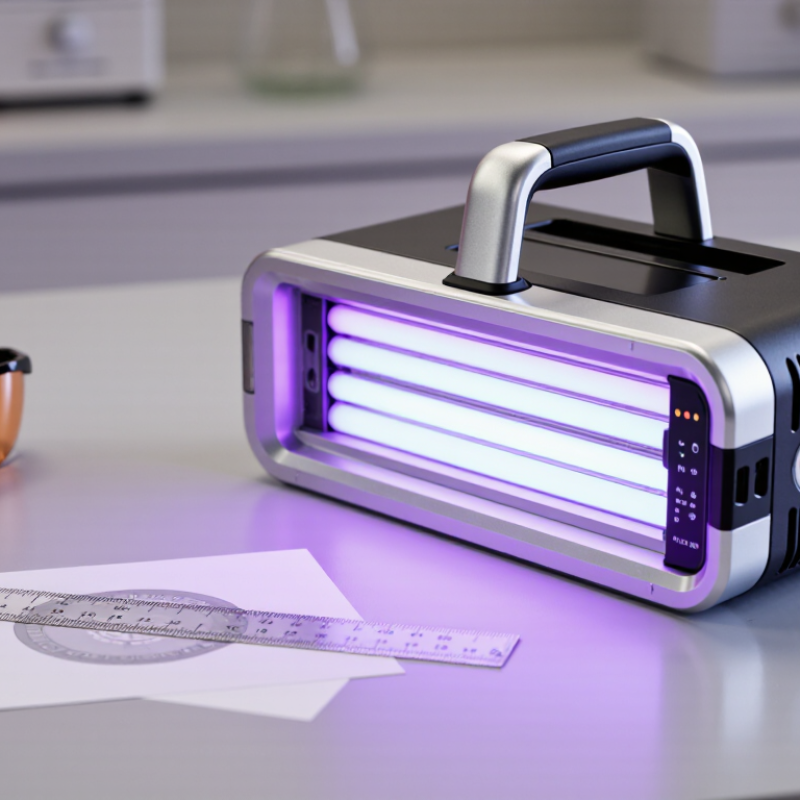
Identify the Intended Application and Required UV Type
Before comparing handheld lamps, define the job the light must do. A lamp for checking fluorescent marks is not automatically suitable for curing resin or surface disinfection. Write down the target material, working distance, and expected use time. Small details matter.
UVA, usually around 315–400 nanometres, is common for fluorescence inspection and some material-curing tasks. Check that the wavelength matches the material’s requirements; “UVA” alone may be too vague. UVB lamps have narrower specialist uses and call for careful handling. UVC devices are designed for certain disinfection applications, but performance depends on exposure time, distance, and unobstructed surfaces. Shadows can leave areas untreated. Never aim UV light at skin or eyes, and follow the device’s safety instructions.
Match the lamp’s output to the actual task, not the most impressive number on its packaging. Ask for the specified wavelength and verify whether output is reported at a stated distance. A bright-looking beam is not proof of effective treatment. I have found this easy to overlook when comparing compact tools. It is worth checking twice. If the application is unclear, pause before buying and consult the material or equipment supplier. A little uncertainty is better than choosing the wrong UV type.

Identify the Intended Application and Required UV Type
How to use this chart: Match the lamp’s wavelength to its intended task. UV-A is commonly used for fluorescence inspection and curing; UV-B is used in specialized applications such as phototherapy under professional guidance; and UV-C is used in germicidal equipment designed with appropriate exposure safeguards. Always check the product’s specified wavelength and follow its safety instructions.
Compare Wavelength, Output Intensity, and Coverage
When comparing handheld UV lamps, check the stated wavelength before looking at brightness claims. Different UV bands serve different purposes, so a lamp is not suitable for every task just because it emits ultraviolet light. Look for a clear wavelength range in nanometers, rather than a vague label such as “UV.” If the specification is missing, that is a reason to pause.
Output intensity matters at the working distance, not just at the lamp head. A small lamp can feel bright in a dim room yet deliver less energy across a surface from several inches away. Check whether intensity measurements include distance and units. Distance matters. A rating without test conditions is hard to compare, and buyers sometimes overlook this detail. I would not treat electrical wattage as a direct measure of UV performance.
Coverage depends on the beam shape, the target size, and how steadily you can move the lamp. A narrow beam may suit a small inspection area, but it can leave gaps across a wider surface. Check the stated beam angle or coverage area, if provided. Also consider shadows, edges, and reflective surfaces; light may not reach every spot evenly. Keep the lamp’s safety instructions close at hand, especially guidance on eye and skin exposure. Real use is less tidy than a product diagram.
Evaluate Eye and Skin Protection Features
Eye and skin protection should be central when choosing a handheld portable UV lamp. Check the product’s stated wavelength and intended use; “UV” alone is not enough information. A shield, enclosed light source, or automatic shutoff can reduce accidental exposure, but none makes careless handling safe. Never stare into it. Keep the beam away from bare skin, other people, and pets, and follow the operating distance and exposure limits in the manual.
Tips: Choose eye protection specifically rated for the lamp’s wavelength, rather than relying on ordinary sunglasses. Look for clear instructions on coverage, safe distance, and exposure time. If those details are missing, pause before buying.
A timer can help prevent overuse, while a trigger lock or protective cover may limit accidental activation in a bag. These features are useful, not foolproof. A tinted window can look reassuring, yet appearance does not confirm effective UV blocking. Inspect the housing for cracks and test controls only as directed. It is easy to overlook reflections from glossy tiles or metal; adjust the work area, and keep your face out of the beam’s path. If irritation or discomfort occurs, stop using the lamp and seek appropriate professional advice.
7 Handheld Portable UV Lamp Buying Tips for Buyers - Evaluate Eye and Skin Protection Features
| # | Buying Tip | What to Check | Eye and Skin Protection Consideration |
|---|---|---|---|
| 1 | Confirm the UV wavelength | Look for a stated wavelength or range in nanometres, rather than relying on a general “UV” description. UVA is commonly defined as 315–400 nm, UVB as 280–315 nm, and UVC as 100–280 nm. | Different UV bands present different exposure hazards. Do not assume a lamp is safe for eyes or skin based on its appearance or intended use. |
| 2 | Check for shielding and direction control | Review product diagrams and instructions for a shielded light source, a directed beam, or a design that limits UV reaching the operator. | Prefer designs that reduce stray and reflected UV. Keep the beam pointed away from people, and avoid direct or reflected exposure to eyes and uncovered skin. |
| 3 | Look for exposure-prevention controls | Check for features such as a timed shutoff, a trigger that must be held to operate, a tilt or motion shutoff, or a contact-activated switch, where appropriate to the product design. | These controls can help reduce unintended operation, but they do not make direct exposure safe. Confirm how each control works in the manual. |
| 4 | Verify eye-protection guidance | Look for clear instructions identifying suitable protective eyewear for the lamp’s wavelength and exposure conditions. Any eyewear specification should state the relevant wavelength range and protection details. | Ordinary sunglasses are not a substitute for eyewear specifically rated for the relevant UV wavelengths. Never look directly at an operating UV source. |
| 5 | Assess skin-exposure safeguards | Check whether the instructions warn against skin exposure and explain safe handling, operating distance, and any required protective clothing or barriers. | UV exposure can injure skin, and some effects may not be immediately apparent. Do not use a UV lamp on people or animals unless a qualified healthcare professional has specifically directed its use. |
| 6 | Ask for safety test information | Look for accessible safety documentation, including relevant photobiological hazard assessment information. IEC 62471 is a standard used to assess photobiological safety of lamps and lamp systems. | A claim such as “tested” is not enough on its own. Check which model was assessed, what the assessment covers, and whether the instructions explain any exposure limits or precautions. |
| 7 | Read the full operating and storage instructions | Confirm the manual describes intended uses, prohibited uses, handling, cleaning, battery or charging precautions, and how to store the lamp securely when not in use. | Choose a product with specific, understandable warnings. Keep it out of reach of children and never rely on visible light—or the absence of visible light—to judge whether UV is being emitted. |
Safety note: UV lamps can harm eyes and skin. Follow the product instructions, use suitable protection for the specified wavelength, and avoid exposing people or animals to the beam.
Check Portability, Battery Life, and Build Quality
A handheld UV lamp should feel manageable before you consider its extra features. Check its weight, grip shape, and balance; a heavy head can make the wrist tire during repeated checks. A textured handle helps when hands are slightly damp, but it should not feel sharp or awkward. Try to picture carrying it in a small tool bag. Will the switch turn on by accident? A simple cover or firm button can prevent that.
Battery life depends on brightness, usage, and battery condition, so treat advertised runtime as a guide rather than a guarantee. Look for a clear charge indicator and a charging method that suits your routine. If you use the lamp in short bursts, standby drain still matters. Check whether the battery can be replaced; otherwise, a worn battery may shorten the lamp’s useful life. Small detail. Easy to overlook.
Build quality shows in the casing, lens cover, hinges, and charging port. Look for tight seams and parts that do not rattle when gently shaken. A rubberized exterior may improve grip, though it can collect dust. Read the manual for the lamp’s intended use and exposure precautions, and never look directly at an operating UV source. I have found that a compact design is not automatically a practical one: cramped controls can slow down a simple task. Choose a model that feels sturdy and comfortable in your actual setting.
Review Certifications, Warranty, and Overall Cost
Before comparing prices, ask for the exact safety standard and an independent test report. A printed “UV-C” claim is not proof of output or safe construction. The FDA’s 2021 guidance warns that some UV-C lamps can injure eyes or skin within seconds. That matters. Look for photobiological safety testing, clear operating instructions, and a guard or shutoff that limits accidental exposure. Check that the warranty covers the lamp, battery, and charging parts, not just the outer casing.
Calculate the cost beyond the shelf price. A low-cost unit may need frequent battery replacement, while a pricier lamp may have a short warranty or costly parts. Ask how output was measured, at what distance, and after how many hours of use. These details affect real performance; advertised exposure times alone can mislead. I would keep the test report and warranty terms beside the product listing before buying. Not glamorous, but useful. If the seller cannot explain the certification or provide test documentation, treat that uncertainty as a cost too.